THE BATTLE OF THE KETTLES
(from Collins' History of Kentucky)
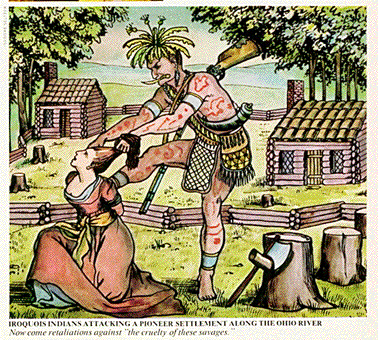
THE BATTLE OF THE KETTLES
Henry Crist was born in the state of Virginia, in the year 1764. During
the revolutionary war, his father, with a numerous family, emigrated to
the western part of Pennsylvania, from whence young Henry and other ardent
youths of the neighborhood, made frequent and daring excursions into the
western wllderness; sometimes into what is now the state of Ohio, sometimes
to Limestone, (now Maysville ) and finally to the falls of the Ohio, which
place he first visited in 1779. The buffalo and deer had elearly indicated
to the early~settlers, those places whera salt water was to be found. The
greatdifficulty of importing salt, the increasing temand and high price
of the article, encouraged the attempt to manufacture here at a very early
day. Salt was made at Bullitt's lick, now in Bullitt county, over ninety
years ago.
In tourist's excursions to the west, he had become acquainted and associated
with an enterprising Dutchman, named Myers, a land agent and general locator,
and in whose name more land has been entered than in that of almost any
other man in the west. This pursuit of locator of lands, brought Crist at
a very oarly day to Bullitt's lick, where he took a prominent and active
part in some of those seenes which have contrihoted to the notoriety of
that renowned resort of all who lived within fifty miles around in the first
settlement of the country. Ilere the first salt was made in Kentucky, and
here from five hundred to a thousand men were collected together in the
various branches of salt making, as well as buying of, selling to, and guarding
the salt makers, when Louisville and Lexington could boast but a few hovels,
and when the buffalo slept in security around the base of Cap
In May, 1788, a flat boat loaded with kettles, intended far the manufacture
of salt at Bu11itt's lick, left Louisville with thirteen persons, twelve
armed men and one woman, on board. The boat and cargo were owned hy Henry
Crist and Solomoh Spears; and the company consisted of Crist, Spears, Chnsllan
Crepps, Thomas Floyd, Joseph Boyce, Evans Moore, an Irishman named Fossett,
and five others, and a troman, whose names the writer cannot now recollect,
though he has heard Crist often repeat them. The intention of the party
was to descend the Ohio, which was then very high. to the mouth of Salt
river, and then ascend tho latter river, the current of svhich was entirely
deadened by back water from the Ohiu, to a place near the licks, called
JInd G~rrison, which was a temporary fortification, constructed of two rows
of slight stochades, and the space betv~een filled with mud and ~ravel from
the bank of the rivet hard by. Tbe works enclosed a space of about half
an acre, and stood-about midway between Bullitt's lick and the: falls of
Salt river, where Shepherdsville now stands. These works were then occupied
by the families of tbe salt makers, and those who-hunted te supply them
with food, and aeted also as an adranced guard to give notiee of the approach
of any eonsiderable hody of men.
On the 25th of May, the boat entered Salt river, and the hands commenced
working her up with sweep-oars. There was no current one way or the other-
while in the Ohio, the great breadth of the nYer secured them against any
sudden attack, but when they came into Salt river, they were within reach
of the Iridian rifle from either shore. It became necessary, therefore,
to send out scouts, to apprise them of any danger ahead. In the evening
of tbe first day of their as. oent- of the river, Crist and Floyd went ashore
to reconnoitre the bank of the river ahead of the boat. Late in the evening
they discovered~ a fresh trail. but:-for want of light, they could not make
out the number of Indians. They remamed out all night,~but made no further
discoveries. In the morning, as they vvere re" turning down the river
toviards the boat, they heard a number-of guns, wbich tbey believed to be
Indians killing game for breakfast. They hastened back to the boat aqd communicated
what they had heard and seen.
They pulled on up the river until about eight o'clock. and arrived at a
point eight mileis belo~v the mouth of the Rolling tork, where they drew
into shore on the north side of the r;Yer, now in Bullitt county,- intending
to land and cook and eat their bteakfast. As-they drew into shore, they
heard the gobbling of turkeys (as they~supposed3 OR the bank where they
were going to land, and: as the boat touched, Fossett ~and- another sprang
ashore, with their guns in their hands, tc
shoot turkeys. They were oautioned of their danger, but disregarding the
adm`nition, hastily ascended the bank. Their oompanions in the boat had
barely lost siaht of them, when they heard a volley of rifles diseharged
all at onee on the bank immediately above, sucoeeded hy a yell of savages
so terriGo as to induce a belief that the woods were filled with Indians.
This attaok, so sudden and violent. took the boat's oompany by surprise;
and they had barely time to seiza their rifles and place themselves in a
posture of defenoe, when Fossett and his companion eame dashing down the
bank, hotly pursued by a large body of Indi. ans. Crist stood in the bow
of the boat, with his ri'de in his hand. At the first sight of the enemy,
he brought his gun to his face, but instantly pereeived that the objeet
of his aim was a white man, and a sudden thought flashed aoross his mind,
that the enemy was a omnpany of surveyors that he knew to be then in the
woods, and that the attaok was made in sport, &cc., Iet his gun down,
and at the s ame time his white foeman sunk out of his sight behind the
bank. But the firing had begun in good earnest on both sides. Crist aaain
brought his rifle to his face, and as he did so the white man's head was
rising over tbe bank, with his gun also drawn up and presented. Crist got
the fire on him, and at the oraok of his rifle the white man fell forward
dead. Fossett's hunting oompanion plunged into the water, and got in safely
at the bow of the boat. But Fossett's arm was broken by the first fire on
the hill. The boat, owing to the hiah water, did not tonch the land, and
he got into the river further toward the stern, and swam round with his
gun in h:s left hand, and was taken safely into the stern. So intent were
the Indians on the pursuit of their prey, that many of them ran to the vvater's
edge, struck and shot at Fossett and his oompanion while they were getting
into the boat, and some even seized the bor.t and attempted to draw it nearer
the shore. In this attempt many of the ludians perished; some were shot
dead as they approached the boat, others were killed in the river, and it
required the most stubborn resistance and determined valor to keep them
from oarrying the boat by assault. Repulsed in their efforts to board the
boat, the savages vvithdrew higher up the bank, and taking their stations
behind trees. oommenced a regular and galling fire, which was returned with
the spirit of brave men rendered desperate by the certain knowledge that
no quarter would be given, and tbat it was an issue of victory or death
to every soul on board.
- The boat had a log-chain for a cable, and when she was first brought ashore,
the ehain was thrown round a small tree that stood in the water's edge,
and the hook run through one of the links. This had been done before the
first fire
was made upon Fossett on shore. The kettles in the boat had been ranked
up - along the sides, leaving an open gangway through the middle of the
boat from: bow to stern. Unfortunately, the bow lay to shore, so that the
guns of the Indians raked the whole length of the gangway, and their fire
was eonstant and deatruetive. Spears and several others of the bravest men
had already fallen, some killed and others mortally wounded. From the commeneement
of the battle, many efforts had been made to disengage the boat from the
shore, all of which had failed. The hope was that, if they oould onee loose
the cable, the boat would drift out of the reach of the enemy's guns; but
any attempt to do this by hand would expose the person to certain destruction.
Fossett's right arm was broken, and he oould no longer handle his rifle.
He got a pole, and placing himself low down in the bow of the boat, commenced
punching at the hook of the chain, but the point of the hook was turned
from him, and all his efforts asemed only to drive it further into the link.
He at length discovered where a small limb had been cut from the pole, and
left a knot about an inch long; this -- l~not-'after a number of efforts,
he placed against the point of the hook, and, Jerking pole suddenly towards
him, threw the hook out of the link. The chain fell, and : - boat drifted
slowly out from the bank; and by means of an oar worked over
~r~ J ~e, 4le boat was brought into the middle of the river, with her side
to the shore, hiish protected them from the fire of the Indians. The battle
had now lasted up
j '~ds of an hour. 'rhe odds aoainst the erew was at least ten to one. The
fire i~ -r"~ d been very destruetive on both sidos, and a great many
of the Indians had been :~illed; but if the boat had remained much longer
at the shore, it was manifest `~l~t there would have beeu none of the clew
left to tell the tale of their disaster.
~b ~-The-survivors had now time to look round upon the havoc that had been
mads ~tbair Iittle band. Five of their companions lay dead in the gangway-Spears
,
Floyd, Fossets and Boyee were wounded-Crepps, Crist and Moore remained unhurt.
It was evident that Spears' wound was mortal, and that he could survive
but a few moments. He urged the survivors to run the boat to the opposite
side of the river. and save themselves by immediate flight, and leave him
to his fate. Crepps and Crist positively refused.
But the boat was gradually nearing the southern shore of the river. At this
tlme the Indians, to the number of forty or fifty were seen crossing the
river above, at a few hundred yards distance, some on iogs, and some swimming
and earryine. their rifles over their heads. The escape of the boat was
now hopeless, as there was a large body of Indians on each side of the river.
If the boat had been earried immediately to the opposite side of the river
as soon as her eable was loosed, the survivors might have escaped; but to
such minds and hearts, the idea of leaving their dyine friends to the merey
of the Indian tomahawk was insupportable. The boat at lengrth touched the
southern shore-a hasty preparation was made to bear the wounded into the
woods-Floyd, Fossett and Boyce got to land, and sought coneealment in the
thickets. Crepps and Crist turned to their suffering friend, Spears. but
death had kindly stepped in and cut short the savae;e triumph. The woman
now remained. They offered to assist ber to shore, that she might take her
chance of escape in the woods; but the danger of her position, and the scenes
of blood and death around her, had overpowered her senses, and no entreaty
or remonstrance could prevail with her to move. She sat with her face buried
in her hands, and no effort could make her sensible that there was any hope
of escape.
The Indians had gained the south side of the river, and were yelling like
bloodhounds as they ran down towards the hoat, which they now looked upon
as their certain prey Crepps and Crist seized a rifle apiece. and ascended
the river bank; at the top of the hill they met the savages and charged
them with a shout. Crepps fired upon them, but Cnst, in his haste had taken
up Fossett's gun, which had got wet as he swam with it to the boat on the
opposite side-it missed fire. At this time Moore passed them and escaped.
The Indians, when eharged by Grepps and Crist, fell back mto a ravine that
put into the river bnmediately above them. Crist and Crepps again commenced
their flight. The Indians rallied and rose from the ravine, and fired a
volley at them as they fled. Crepps received a ball in his left side,a bullet
struck Crist's heel, and completely crushed the bones of his foot. They
parted, and met no more. The Indians, intent on plunder, did not pursue
them, but rushed into the boat. Crist heard one long, agonizing shriek frorn
the unfortunate woman, and the wild shouts of the savages, as they possessed
themselves of the spoils of a costly but barren victory.
Crepps, in the oourse of the next day, arrived in the neighborhood of Long
Lick, and being unable to travel farther, laid down in the woods to die.
Moore alone eseaped unhurt. and brought in the tidings of the defeat of
the boat. The eountry was at onee roused. Crepps was found, and brought
in, but died about the time he reached home. Crist described Crepps as a
tall, fair haired, handsome man: kind, brave, and enterprising, and possessed
of all those high and striking qualities that gave the heroic stamp to that
hardy race of pioneers amongst whom he had lived and died. He had been the
lion of the fieht. By exposing himself to the most imminent peril, he inspirited
his eompanions with his own contempt of danger. He and Crist had stood over
lossett, and kept the Indians treed while he disengaged the cable, and his
eoolness durine the long bloody struggle of the day, had won the admiration
of Crist himself-than whoil; a more dauntless man had never eontended with
mortal foe. Crepps left a yoaner wife and one son, then an infant. His wife
was enceinte at the time of his death -the posthumous ehild was a daughter,became
the wife of the Hon. Charles A. Wickliffe. The son died shortly after he
arrived at man's estate
Crist was so disabled by the wound that he eould not walk. The bones ot
his heel were crushed. He erept into a thichet and laid down-his wound bled
profusely. He could not remain here long. His feet were llOW of no use to
him. He bound his moccasins on his knees, and commenced his journey. Piece
by pieee his hat, hunting shirt, and vest were consumed to shield his hands
against the rugged rocks which lay in his way. He crawled on all day up
the river, and at night crossed over to the north side upon a log that he
rolled down the bank. He concealed hirnself in a thicket and tried to sleep-but
pain and exhaustion and loss of blood had driven sleep from his eyes. His
foot and leg were much swollen and inflamed. Guided by the stars he crept
on again-between midnight and day he came in sight of a camp fire, and heard
the barking
of a dog. A number of Indians rose up from around the fire, and he crept
softly away from the light. He laid down and remained quiet for some time.
When all was still again, he resumed his slow and painful journey. He crawled
into a small braneh, and kept on down it for some distanee upon the roeks,
that he might leave no trace behind him. At daylight, he aseended an eminenee
of eonsiderable height to aseertain, if possible, where he was, and how
to shape his future course; but all around was wildern'ess. He was aiming
to reach Bullitt's liek, now about eight miles distant, and his progress
was not half a mile an hour. He toiled on all day-night came on-the second
night of his painful journey. Since leaving the small branch the night before,
he had found no water-since the day before the battle he had not tasted
food. Worn down with hunger want of sleep, aeute pain, and raging thirst,
he ]aid himself down to die. But his sufferings were not to end here-guided
again by the stars, he struggled on. Every rag that he eould interpose between
the rugged stones and his, bleeding hands and knee (for he eould now use
but one), was worn away. The morning came -the morning of the third day;
it brought him but little hope; but the indomitable spirit vvithin him disdained
to yield, and during the day he made what progress he could. As the evening
drew on, he became aware that he was in the vicinity of Bullitt's lick;
but he could go no further; nature had made her last effort, and he laid
himselfdown and prayed that death would speedily end his sufferings.
When darkness came on, from where he lay he could see the hundred fires
of the furnaces at the licks all glowing; and he even fancied he could see
the dusky forms of the firemen as they passed to and fro around the pits,
but they were more than a half mile off, and how was he to reach them I
He had not eaten a rnorsel in four days, he had been drained of almost his
last drop of blood, the wounded leg had become so stiff and swollen that
for the last two days and nights he had dragged it after him; the flesh
was worn from bis knee and from the palms of his hands. Relief was in his
sight, but to reach it was impossible. Suddenly he heard the tramp of a
horse's feet approaching him, and hope sprang up once more in his breast.
The sound came nearer and still more near. A path ran near the place where
he lay, a man on horse-back approached within a few rods of him, he mustered
his remaining strength, and hailed him; but to his utter surprise and dismay.
the horseman turned suddenly and galloped off towards the Licks. Despair
now seized him. To die alone of hunger and thirst, in sight of hundreds
and of plenty, seemed to him the last dregs of the bitterest eup that fate
eould offer to mortal lips. O! that he could have fallen by the side of
his friends in the proud battle! That he could have met the Indian tomahawk,
and died in the strength of his manhood; and not have been doomed to ]inger
out his life in days and nights of pain and agony, and to die by piecemeal
in childish despair. While these thoughts were passing in his mind, the
horseman (a negro), regained the Licks and alarmed the people there with
the intelligenee that the Indians were approaching. On being interrogated,
all the account he could give was, that some person had ealled to him in
the woods a half mile off, and called him by the wrong name. It was manifest
it was not Indians; and forthwith a number of men set out, guided by the
negro, to the place. Crist's hopes again revived, when he heard voices,
and saw lights approaching. They eame near and hailed. Crist knew the voice,
and ealled to the man by name. This removed all doubt, and they approached
the spot where be lay. A sad and mournful sight was before them. A man that
had left them but a few days before, in the bloom of youth, health and buoyant
spirits, now lay stretehed upon the earth, a worn and mangled skeleton unable
to lift a hand to bid them welome. They bore him home. The ball was extracted;
but his recovery was slow and doubtful. It was a year before he was a man
again.
The woman in the boat was carried a prisoner to Canada. Ten years afterwards,
Crist met her again in Kentucky. She had been redeemed by an ludian trader,
and brought into Wayne's eamp on the Maumee, and restored to her friends.
She informed Crist that the body of Indians which made the attack nn the
boat numbered over one bundred and twenty, of whom about thirty were killed
in the engagement. This account was confirmed by Indians whom Crist met
with afterwards, and who had been in the battle. They told Crist that the
boat's crew fought more like devils than rnen. and if they had taken one
of them prisonet,they would have roasted him alive. Crist was afterwards
a member of the Kentucky Legislature, and in 1848 was a ember of Congress.
He died at his residence in Bullitt County in August, 1844, aged eighty
years.