LEBANON JUNCTION
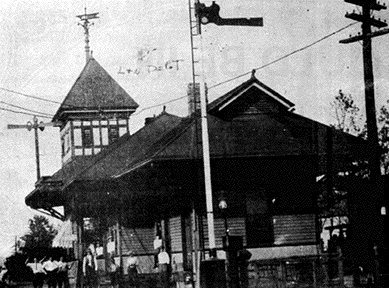
Settlers had been in the vicinity for several years before Lebanon
Junction became a town. Tradition has the first settler a man by the name
of Stark moving there in the 1780's. This may have been early for a permanent
house in the area outside of a fort because the threat of Indians had not
abated
until at a later time.
The name of the town is taken from its location at the branch of the railroad
that went to Lebanon, Kentucky, in 1857. It is probable that several families
were living in the area prior to the coming of the railroad and the community
known under another name. Perhaps, the Lebanon Junction area played a more
prominent role during the civil war than any other section of the county.
The railroad was a con- stant target of the Confederate strategy. In 1861
Confederates burned the bridge over Rolling Fork and General Sherman had
his headquarters in the rail station at Lebanon Junction. In 1862 the bridge
was destroyed on Cane Run and the Lebanon Branch of the railroad, and a
skirmish at the Rolling Fork saw Morgan's Calvary pushed back. In 1863 there
was a skirmish at Lebanon Junction.
In 1872 the Knights of Pythias and Rev. Daniel Collier jointly constructed
a meeting house, all denominations, except the Catholics, used the building
for worship while the Knights used it for their organization meetings.
A school in 1880 had 80 pupils enrolled. The town was incorporated in 1895.
The first officers were as follows: J.L. Thompson, Police Judge; J.E. Masden,
Town Marshall; R.A. Collings, Assessor; R.M. Hocker, T.B. Meals, J.E. Johnson,
William Farrar, and William Hibbs, were trustees.
The Lebanon Junction Bank was organized in 1897. Soon after the bank opened
the safe was robbed but no money was there so the thieves got nothing. The
brick building was built in 1901. In 1912 the town contained four general
merchandise stores; one ladies & gents furnishings; a drug store; a
grocery, a bakery & restaurant; two barber shops; one butchershop; three
shoe maker shops; one livery and sale stable; one blacksmith shop and the
population was 1200. On May 24, 1912, a terrible fire raged through the
town destroying three dry goods stores, a drug store, clothes cleaning store,
pool room, two houses and the Knights of Pythias Hall. The first fire protection
for the citizens was probably bucket brigades. The L&N had a switch
engine with a long hose that was used to protect those areas within reach
of the track. In 1912 or 1915 an 8 man pumper was purchased and in 1925
a model T truck chasis was bought. During this year the first
volunteer Fire Department was organized with C.C. MacPherson its first chief.
Electricity was brought to town in 1927, the brick school on the hill was
built in 1932 and the
first water system was established in 1935. By the 1920's the L&N had
built a yard at Lebanon Junction. When the yard was in use the town enjoyed
prosperity and boom. For a while it was the largest city in the county.
When the diesel engine was introduced it enabled a train to go farther with
less stops so the Lebanon Junction yard was gradually phased out. After
this the town began to decline from its former role.
May 15-21, 1938 was National Airmail Week. Lebanon Junction and Shepherdsville
celebrated the occasion by the postmistress at Shepherdsvilie driving the
mail to Lebanon Junction where pilot W.B. Samuels flew it to Louisville.
The Lions Club was organized in 1941 with W.T. Adams the first president.
In 1973 a new modem fire house was started and the Peoples Bank Agency opened
a new office.