PITTS POINT
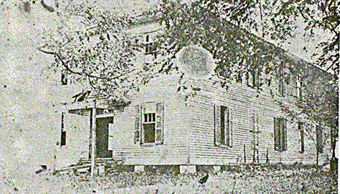
PITTS POINT ACADEMY
At the junction of the Rolling Fork and Salt Rivers was a town,
that at one time in Bullitt's history, was a bustling important river town.
Originally it was called Pittstown. In August of 1831 Abraham and Hannah
Froman sold 600 acres to two'brothers James G. and John S. Pitts for $1500
"current" money. Abraham Froman was operating a ferry across the
river at that time. The Pitt brothers laid off their town and filed the
plot which is in the deed books in the county court clerk's office. The
plot is in three colors and shows the additions made to the town, one of
which was by J.J. Froman, sometime prior to 1860. A Post Office was established
in 1842 and the first public school was organized about 1850. In 1852 Sam
Goldsmith started a fish business which he may have operated from a boat.
The population in 1860 was 300.
According to G.W. Howe's Kentucky State Gazetteer and Business Directory
for 1859 and 1860, No. I the town contained the following businesses and
professions.
Benett, N.D. - physician
Boyer, Wm. H. - carpenter
Butler Lodge, No. 194 - Masonic
Carpenter & Conell-Franklin Hotel proprietors
Caswell & Co. - bakers
Chaddie, Wm. - surveyor
Collings, S.W.-saddle and harness maker
Rolling Fork Seminary - Miss Ellen Stiles, Principal
Runner, Sammuel - tailor
Snellen, Z.P. - mason & builder
Sutlan, W.D. - painter
Tydings, C.B. - physician
Between 1864 and 1866 Pitt's Point Male and Female Academy was started.
It was a well known institution. In 1865 a battle was fought by the townspeople
against a band of guerrillas who were/ led by two brothers named Wigginton.
The town derived its importance from the place where it was located. Salt
River was not navigable to Shepherdsville but was to a place beyond Pit
t's Point. This made the town the shipping point for most goods produced
in the county. Products would be loaded on wagons and taken to the town
where they were loaded on one of the small packetts or steamers that put
to port there. When the steamboat as replaced by the automobile and other
forms of transportation Pitts Point declined until the entire area was purchased
by the Federal Government and today is part of the Fort Knox military reservation.
The Ghost Town of Bullitt County-1956
You don't have to go out West to find a genuine ghost town. There's one
less than 20 miles from Louisville.
That's as the crow flies. The Kentucky ghost town is in such an isolated
location that it might be easier to go West, after all, to visit one.
Pitts Point, at the confluence of Salt River and Rolling Fork in Bullitt
County, is so abandoned that it would take an individual with a strong heart
to walk down its spooky Main Street without jumping with the snapping of
a twig. Ghosts seem to be hiding behind every tree and tumbledown building.
This ghost town was once a bustling river landing. At its peak it was a
community of severai hundred persons. But as the steamboat trade began to
decline, so did Pitts Point's population.
Still, a prosperous little town continued to exist until expansion of Fort
Knox some 15 years ago. At that time the Government purchased the entire
town.
All of the residents were paid for their homes and moved elsewhere. Yet
the houses and business places of Pitts Point were left standing and have
remained so-more or less-to this day.
Some 14 years of flood, storm, forest fire and practice artillery shelling
have left their effect on the town. The numerous forest fires which have
swept the Fort Knox reservation somehow have spared the town site. But many
of the buildings have collapsed, and trees and undergrowth have blocked
the streets.
It is almost impossible to get to Pitts Point today by vehicle. It can be
done by following a rugged tank road from Belmont. That's by way of a nine-
mile trail which isn't fit for a horse to travel, although I did manage
to make this trip recently in a four-wheel-drive jeep. But the best way
to reach Kentucky's almost-forgotten ghost town is by boat from West Point,
on the Ohio at the mouth of Salt River. This is a 14-mile trip through the
spectacular gorges of the lower Salt River Valley. It's the way I chose
for my second visit to Pitts Point.
To reach the town from either direction, however, it is necessary to get
a pass from the commanding general at Fort Knox, as Pitts Point is located
some eight miles inside the reservation boundary and in the center of an
artillery range.
The exact date of the first settlement at Pitts Point is uncertain. But
it was before 1790, or shortly after Col. Thomas Bullitt discovered and
developed the nearby salt lick which became known as Bullitt's Lick.
The settlement received its name from the resemblance of its location-on
the point of two streams-to another famous frontier station, Fort Pitt,
which is the present day Pittsburgh. When salt makers came down the Ohio
River from Fort Pitt, they named the area Pitts Point.
This became the shipping point for all the salt produced at Bullitt's Lick.
The salt was loaded on keelboats and taken down Salt River to West Point,
there to be shipped to various points up and down the Ohio River.
In early days a customs inspection point for hemp, tobacco and salt was
established at Pitts Point and a large warehouse was erected for storage
of these cornmodities.
With the coming of the steamboat, Pitts Point gained even more importance.
It was practically the head of navigation on Salt River in periods of low
water. Several packets operated daily between Pitts Point and Louisville.
Old-timers reminisce over pleasant trips to Louisville aboard the Mattie
Hays, Nellie Grant and the Bellevue, which were in the fleet of fine boats
which operated on Salt River.
After the salt works nearby Bullitt's Lick started to decline, Pitts Point
continued to bustle, for the nearby hills supported numerous sawmills and
lumber products had to be shipped out.
The Civil War probably saw Pitts Point at its peak of activity. In its streets
a battle was fought between the home guard and a guerilla band.
Shortly after the war, Pitts Point became a college town. It was in this
period that numerous small colleges cropped up all over the country. Pitts
Point Academy became one of the best known institutions of higher learning
in Central Kentucky. Numerous present-day residents of Bullitt and Hardin
Counties attended the school.
Portions of the old college building are still standing-as are some of the
walls of other buildings-but from all indications the next hard wind may
blow this relic into Salt River.
Tradition says it was to Pitts Point that Henry Clay took his famous trip
up Salt River during the 1832 election which resulted in the expression
in which defeated political candidates are described as having "gone
up Salt River."
During its best years, there were several stores at Pitts Point, as well
as a post office, a hotel and the college. One ferry crossed Salt River
and another crossed Rolling Fork.
Towering above the town is Dawson Knob, one of the highest hills in this
section of Kentucky, with an elevation of 1,042 feet. Young folks who used
to climb Iroquois Hill at Louisville about 20 years ago to see an airplane
beacon flashing far to the south were watching the one which was situated
atop of Dawson Knob.
As I turned to leave Pitts Point after my visit, two large deer leaped over
a honeysuckle hedge near the abandoned church and went bounding thr ough
the forgotten village. From all visible signs, they are the only residents
of Pitts Point in 1956- unless you want to count the ghosts.