Except for the saltworks at Bullitt's Lick which was, at times,
called Saltsburg, Shepherdsville is the oldest town in Bullitt
County. Its proximity to the salt works and the river ford at
the falls of Salt River made it an ideal location for Adam Shepherd
to establish his namesake. In 1793 Adam purchased 900 acres on
the north bank of Salt River upon which he laid out streets and
alleys and Shepherdsville was born.
When the county was created in 1796, Shepherdsville was chosen
as the county seat and the first county court was held in the
home of Benjamin Summers in 1797. At present we do not know who
the first town officials were. In 1800 the town had a population
of 96. The first county court house was erected in 1804 in the
square, south of the present day location of the Bullitt County
Bank. The present court house was erected in 1900. Thomas T. Grayson
was the first postmaster of the post office established in 1806.
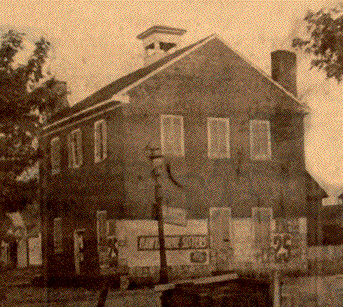
Somewhere around 1816 a "Bank of Shepherdsville" was
in operation. Tradition says the old store building on the west
side of Buckman Street by the bridge, was the site of a bank,
the oldest in Kentucky, if proved, the old building will attain
a new
and important being.
Circa 1819 a forge, rolling mill and grist mill was erected by
John W. Beckwith (Hartley, Charles "Iron Products Manufacturing
in Early Nineteenth Century Bullitt County"-a preliminary
report). These were located at a dam constructed on Salt River.
The water was harnessed by the dam, fed into a race which led
to a large water wheel thus supplying power to operate the mills.
This business changed hands several times and was probably out
of existence by 1866. In 1847, according to Collins, History of
Kentucky, the town contained one Methodist church (appropriated
to the use of Bullitt Academy) four stores, two groceries, five
doctors, seven lawyers, three taverns and 12 mechanical trades.
The population was about 400.
There were periodic outbreaks of cholora in the county. In 1854
19 people died, many from Shepherdsville. The L&N Railroad
went through the city circa1855. According to G.W. Howe's Kentucky
State Gazetteer and Business Directory for 1859 and 1860 No. 1.
the town contained a court house, jail, two churches, one academy,
two general stores, one confectionery and several mechanical trades.
The population was about 200.
During the Civil War the Railroad bridge over Salt River was destroyed
by John Hunt Morgan on his "Christmas Raid". An embargo
was placed on goods being shipped south from Louisville so the
merchants loaded their wares on wagons and carried them to Shepherdsville
then loaded them on the train. The Pioneer News was established
in 1882 making it the oldest established newspaper in the county.
On December 24, 1917 one of the worst disasters in the city occurred,
when a train loaded with passengers wrecked near the present Hwy
44 crossing. Several people of Shepherdsville and Bullitt Count
were killed. On Dec. 30, 1973, a freight train derailed leaving
26 cars strewn about like playthings and one residence badly damaged.
Being situated as close to the river as it is the city is subject
to periodic flooding, the last being in 1964 and 1961, with the
worst being the flood of 1937.
(From a booklet produced in 1971 by the Bullitt Co. Historical Commission- no attributions given.)
Back in 1780, the settlers in Kentucky traveled hundreds of miles
through Indian-filled forests to buy salt at the first refinery
west of the Alleghenies, which was started at Shepherdsville,
now the seat of Bullitt County.
Half a century later the grandchildren of the same settlers were
making summer trips to Shepherdsville to enjoy the social life
and the curative treatment of Paraquet Springs, where a hotel
with several hundred rooms was filled the season long.
The early settlers who wanted cooking salt and their descendants
who sought the more complex salts of Paraquet Springs were both
following trails beaten centuries before by the buffalo.
From the Chesapeake Bay across the Blue Ridge a buffalo path lay
in the early years of American settlement. Pioneers coming upon
the prehistoric highway must have wondered where it would lead
them.
It led, like trails from many other directions, to the Bullitt
County lick at Shepherdsville.
Making salt was a profitable business in the days when all men
rode horseback. The prevailing price was around $24 a bushel,
payable in Spanish milled dollars.
Salt hunters would come to Buffalo County in large companies,
because two or three men stood a poor show to get there and back
with the woods full of red men. Each member of a party would ride
one horse and lead two pack animals, which were covered with rawhide
blankets so that the dripping brine would not take off all their
hair.
The stream of salt and silver soon created what was, for those
times, a city. Though it started about 1778 with the unassuming
name of Mud Garrison, Shepherdsville was a center of prosperous
industries before Louisville, according to Doctor G.G. Crist,
whose grandfather, Gen. Henry Crist, represented Kentucky in Congress
from 1809 to 1811.
The first bank in the state, Doctor Crist says, was in a small
stone house that is still standing on Main Street in Shepherdsville.
The old stone vault may be seen yet.
As late as 1812, we are told, many Louisvillians sold themselves
out and bought property in Shepherdsville in the belief that the
Salt River town would be the rnetropolis of Kentucky.
In 1800 a steel and iron manufactory was set up half a mile below
Shepherdsville on the river. The rnachinery was run by were heated
with charcoal. By 1820 the wood on the north side of the Salt
River had been exhausted for four miles in every direction.
Pig iron for the furnaces was hauled six miles by wagon from Belmont,
and the wrought iron and nails needed by smiths for hundreds of
miles around were hauled away from the Querry and Taylor works.
The dam across Salt River was made of hewn timbers and bolted
to the bed rock of the stream. Years afterward, Doctor Crist's
father used to dig out lead that had been flowed around the bolt
ends. He and others would take advantage of low water to lay in
their fall supply of bullet metal for rn uzzle- loaders.
Although whisky has admittedly been seen in Shepherdsville since
theitown was in its glory 130 years ago, Bullitt County voted
against liquor under local option years before the Volstead Act.
The shooting in a saloon of one of the best physicians in Shepherdsville
stirred up feeling that was a long time in dying down.
(From an unattributed copy of a 1926 newspaper article)