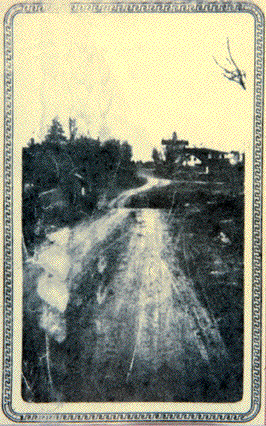
Settlements along the Salt River had slowly been advanceing
throughout the early part of the 19th century. By
the 1820's the threat of Indians had diminished and the population
of the county was growing. The area that would come
to be known as Mount Washington was a point along one of the early
trails that had been cleared bty axe from the Beargrass Creek
settlements to Cox's settlement on Cox's creek in the 1790's.
This trail was to eventually become the Jackson Pike
from Louisville to Bardstown. Contacts between the important towns
were made through the use of stage roads that were coming into
being. At the junction of the stage road from Louisville and Bardstown
and the road from Shepherdsville to Taylorsville enough people
had gathered in scattered homes that a town was incorporated in
1822. Prior to this the section was known as the "crossroads".
Mt. Vernon was chosen as the town's official name.
At the time the town applied for a post office, it
was discovered that another Mount Vernon existed. Apparently the
postal authorities required a different name, and Mount Washington
was chosen.
According to an old state Gazateer, in 1847 the town contained
3 churches, 2 schools, six stores and groceries, five doctors,
two taverns and twelve mechanical trades. Salt River Lodge No.
180 F & A.M. was char tered in 1849.
Mount Washington was the most populous area in Bullitt
County on the 1850 census with a population of about 700.
According to an interview published in
1930 in the Courier Journal, Godfrey Wolfe operated a tanyard
and leather industry in 1850. Lucien Brown ran a school for girls
which had burned before the war between the states. Squire Fidler
operated a rifle factory; L.N. Parrish and Peyton Burdette each
ran a coffin shop; Charles Hall and Mr. Wright each operated a
tavern and hotel; Linton Snapp, Billy Smith, Joe Huff, Bill Hall
and George Abel ran grocery stores. The old Buck Mill ground flour
and contained a milling machine from which wood furniture was
produced. It also had a wool carding machine, making it a center
of industry in those days.
During the Civil War, on Oct. 3, 4, 5, 1862 a skirmish occurred
between the Federals and Confederates outside Mt. Washington.
It began on Floyd's Fork and ended at the Salt River with neither
side stopping to make a full fight.
According to a booklet produced by the Bullitt County Historical
Commision in 1971, during the 1880's McAfee Funeral Home was established
and in 1885 W.H. McFarland began the McFarland Funeral Home. Around
1900 Bill Ellaby started his law practice while Peyton and Tom
Fox operated a carriage factory and Freeman Ramsey operated a
Piano Factory. 1901, a branch of the Peoples Bank of Shepherdsville
was opened with W.L. McGee as cashier. In 1909 the bank became
independent and was called the Peoples Bank of Mt. Washington.
Bert Hall was the first president and W.L. McGee continued as
cashier until his death in 1932. In 1925 the old Jackson Highway
was replaced by a new road from Louisville to Bardstown. The section
through the city changed the business location of the city.
By 1930 a combination saw and grist mill was the only semblance
of manufacturing that remained of a once flourishing number of
concerns.During the 1937 flood the citizens of Mt. Washington
showed their desire to help their fellow man by aiding those citizens
that were displaced by the disastrous waters.
On the night of November 18, 1940 a fire broke out that quickly
spread through the town. The town's tallest building, a four-story
Maccabee Hall was ablaze. Fanned by high winds it burned to the
ground. The Jasper Warehouse- a one story frame which had been
the old Methodist Church, burned, then several adjacent buildings
caught fire. Flames leaped across the street and ignited the Cyclone
Store building but it was brought under control when volunteers
from the Jeffersontown Department arrived to assist. Several other
residences ig- nited before the entire conflagration was brought
under control. This brought the attention of the citizens to the
need of a volunteer fire department, which was promptly organized.
The Mt. Washington Lions Club has influenced the direction of
the city. They established Lion's Park, paid for street lighting,
worked to get the first watersystem, and expended approximately
$50,000 on community service from 1948-1959. It is still as active
in the community's welfare.