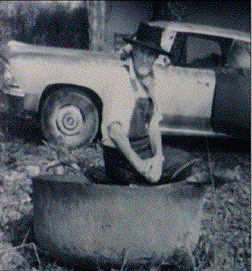
ORIGIN OF THE NAME
"SALT RIVER TIGER"
This article came from the December 16, 1896 issue of the Salt River
Tiger, a short lived newspaper of the 1890's.
In 1818 David Spencer , a flat boat man, was taking a load of goods from
the Salt River area to New Orleans. He passed a steamer that was also on
the way to New Orleans. The Captain called out and asked who Spencer was.
There was a bevy of young girls on the deck of the steamer who were watching
the scene. Taking advantage of the opportunity, Spencer called out "we're
Salt River Tigers". The captain was so delighted with the phrase and
episode that when he arrived in New Orleans he passed the story around until
it culminated in publication of a New Orleans newspaper. Men who fought
in the Mexican and Spanish American wars also called themselves Salt River
Tigers and Col. Philip Lee's confederate company called themselves by the
same name.
FROM THE PROSE PEN OF THE HON. J. W. CROAN, 1897
Probably the most picturesque spot in the county, Bullitt's Lick
proper, the site of the famous salt works. is a basin-like amphitheater
a mile in length. and less than a half mile in width, and is traversed of
uneven, picturesque ridges, flanked by moIE--hill peaks, barren of vegetation.
made so by the action of the salt, which are ten or fifteen feet high.
In the period prior to 1780, the dawning of agriculture in this section,
the fertile land skirting the banks and low bottoms of Salt River were covered
with a luxuriant growth of cane and wild grasses, and were the abodes of
immense herds of buffalo, elk, antelope and deer whose well-rounded saddles
shook on their sides as they roamed the wild fields and tickled the turf
with their ivory-shod toes. It was on the salt-sown amphitheater of Bullitt's
Lick these sleek denizens would come out at night from the cane thickets.
and eat the dirt and enrich their iuicy steaks on the glistening salt flakes.
This was their sporting rink.
Perhaps for centuries before the white man set foot on this part of Kentucky,
only the star-studded heavens had been the silent spectator of their wild
sports and rival feats, as they plunged their hardened heads together like
steam-propelled battering rams, and plowed and tore the earth with tinseled
hoof and horn, tickling each other's ribs with velvet spike. and filling
the air with bellowing sounds and tribal music more thrilling than the minstrelsy
of the ancient Bulls of Bashau.
Time rolled on, and the Shawhanee, Chickasaw and Sioux tribes came riding
on its billows, with flint-faced arrows, scalping-knife and frying pan,
carrying with them the appetite of princes. Their keen instincts and practiced
eyes soon convinced them that they had struck the Mecca of the great hunting
ground. These became co-tenants of the forest, and delighted spectators
of the theatrical performances of their velvet-robed neighbors, and not
a few were the juicy steaks served in a la mode savage style about their
wigwams.
It was not until the year 1775 Thomas HOGAN. an Englishman. father of Lewis
HOGAN, who was a celebrated stonemason in the Knobs in the 1840s; Evan MOORE's
father, Robert CROAN, both Irishmen; Isaac SKINNER. John DUNN, Amos HOGLAN's
father, Adam CAHILL, and a few others were attracted here by the wild reports
of the famous salt deposits and the rich game fields and nut- laden forests.
These dauntless pioneers resolutely set to work building pole cabins and
establishing a permanent settlement preparatory to opening up the afterwards
renowned salt works. Connected with this enterprise were Henry CRIST. Nathaniel
CRIPPS and perhaps others. New recruits were added to the settlement forom
time to time. A great many rude cabins were spee dily built. and in a short
time a thriving and enterprising town had sprung up like magic. Settlements
had been made around Beargrass at Louisville, Harrodsburg, and shortly after
at Elizabethtown. Some fifty wells were sunk., said to have been from 60
to 300 feet in depth, a number of which, and the charcoal beds where the
furnaces were located, are still plainly visible. The large iron kettles
in which the salt water was boiled, were procured from Pittsburg; boated
down the Ohio in flatboats to the mouth of Salt river and up Salt river
to the landing about two miles from the sal-t works. Hundreds of hands were
soon engaged in cutting and hauling the wood to fire the furnaces and draw
the salt water from the wells and manufacture the salt.
Corn was grown on a small scale for bread, and the meat was obtained from
the wild hog supply, buffalo, elk, turkey and deer. then abounding in the
near hills, and richly nut-laden flats. The antelope, deer and elk would
come out of the cane at night to lick the salt a safe distance from the
works; these came in droves, and after scenting and reconnoitering the field,
sometimes for hours. would walk into the trap salted for them when a volley
was poured into them from the deadly rifles that had been secured in rests.
cocked and sighted before night, the
triggers being pulled by lines from ambuscades more than a hundred yards
away.
Bullitt's Lick that day was the El Dorado of the Kentucky district. Salt
was supplied to settlers and traders all over the surrounding country. from
west of the Allegheny mountains to New Orleans and Indiana, there then being
no other salt works west of the Allegheny range. After the country was opened
up and wagon roads were built, the former mode of carrying the saline product
on pack mules was abandoned, and large quantities of whiskey, flour, etc.,
was hauled by axle from Nelson, Washington and Shelby. and traded for the
product of these salt works. Then there was very little money. Continental
paper was the principal currency. and it took one thousand dollars of this
paper to equal one of silver of gold.
In 1790 the elder James CROAN was born at the Salt works, and a few years
later Robt. CROAN, one of the first pioneers, met a horrible fate by being
scalded to death in one of the large kettles of salt water. into which he
had fallen while working around them. About this time, Isaac SKINNER, having
purchased four hundred acres of land in the Knobs, near Cupio now. and John
DUNN. then partners in salt making. dug the original Bullitt's Lick hill
to get to his land.
Shortly prior to this Adam CAHILL, while hauling wood from the chopping,
was captured by a predatory band of Indians and taken on top of one of the
tallest peaks close to the foot of Bullitt's Lick. over one thousand feet
high, at-id lashed to cii-ic- of the tall pines with withes, and whipped
nearly to death. CAHILL was so ugly the Indians would not take his scalp,
and they left him tied to perish at leisure. He was that evening released
by a scout of friends from the salt works. From this circumstance this tall
peak went down in history as Cahill's Knob.
In 1783, Moses HOGLAN's father, from the salt works, and Moses., then a
lad twelve years old. were murderously assaulted by Indians while fishing
in Beech Fork, a few miles above Pitts Point. The father was killed and
Moses taken prisoner. The savages carried young HOGLAN to the northwest
and held him for twelve years. He held the Indian ponies at the battle of
Bloody Ridge, and underwent an experience of peril and hardship. He regained
his liberty after the treaty of 179S. He afterward soldiered under Gen.
HARRISON, and was at the battle of Tippecanoe. Moses HOGLAN was the father
of Judge Lorenza HOGLAN, of Shepherdsville, and Arterberry HOGLAN, of the
Knobs, and other children deceased.
..May, 1788, the desperate battle with the Indians was fought from a flat
boat in Salt river not very far below Pitts Point. The boat and crew, consisting
of twelve men and one woman, enroute from Louisville to the landing on Salt
river not very far below Pitts Point. laden with kettles for the salt works,
was under the lead of Henry CRIST and Nathaniel CRIPPS.
They were attracted by the strategy of the Indians by a sound like the gobbling
of turkeys; thus lured, went ashore with rifle in hand to kill them. They
had not gone far when the Indians attacked them and drove them aboard the
boat which was fastened to the roots of a tree by a log chain cable, and
took shelter behind the kettles that were arranged in rows on the sides
of the boat. The Indians. about 100 strong, rushed upon the deadly rifles,
and many fell before their fire. The boat had pulled out the length of the
chain from the bank and they fought nearly an hour before the chain could
be loosened from its fastening. Finally CRIST took a long pole on the boat
and jobbed it against the hook and it fell out of the link and the craft
floated out into the river and was shoved over to the Hardin side furthest
from the enemy. Seeing the savages swimming across below the boat and most
of the crew being killed, CRIST, badly shot in theheel, Evan MOORE and HOGAN,
unhurt, crawled off the boat and upthe bank into the thick bushes and concealed
themselves.The woman was taken prisoner and Nathaniel CRIPPS and all therest
of the crew were killed.
CRIST,in great agony, after night fall, crawled to the river bank,and finding
a log on the bank, rolled it into the water and floated over to the Bullitt
side, and on his hands and knees crawled through the cane and thick brushes
up Salt river. Traveling at night and laying still in day time to prevent
detection. On the fourth day, worn out and exhausted from loss of blood
and starvation, he came near the salt works in a deep ravine. iust before
night. Seeing some passers in the wood- hopping he hailed them by making
a loud noise; they were afraid to venture toward him, and went to the works
and gave the alarm. The settlers at the salt works went in search and found
CRIST in the ravine concealed in a thicket of bushes, and carried him to
the works almost lifeless. The skin and flesh was worn off his hands and
knees from crawling on them a distance of about eight miles. Gen. Henry
CRIST was permitted to survive this trying ordeal and became afterwards
the first and only representative every sent to Congress from Bullitt County,
I think in the year 1804.
Large quantities of wood was consumed in the manufacture of salt, and before
1800 all the wood that was convenient had been cut off the flats and hill
sides. Newcomers embarked in the enterprise as others dropped out. Last
engaged in the business here were Thomas JOYCE. of Shepherdsville. and William
MOORE. of Bullitt's Lick, their business bein conducted closer to the footof
Bullitt's Lick hill. Wood here being exhausted. They elevated the water
and ran it through bored pine logs under ground down the valley as far as
KINNESON's farm, now TROUTWINE'S, where they manufactured the salt. It was
cheaper to run the water to the wood than haul the wood.
About 1810-20 salt was also made near Old Deposit, now South Park, on the
L. & N. R. R., by Joe BROOKS, a wealthy farmer residing near Brooks
Station. He sunk a large and very deep well and walled it up with pine log
cribbing, and for a number of years did a large business. Large quantities
of the product was stored at Old Deposit, whence the name. Much of this
salt was hauled to the Ohio river and carried over FARNSLEY's Ferry, near
Greenwood now, and supplied to the trade in Indiana. The wood supply being
exhausted here BROOKS built a high crib of pine logs twenty or thirty feet
high, and the salt water was elevated to a large tank on top and conveyed
in bored pine logs to his place, to a point just north of Brooks Station.
where the salt was made. The old crib. partially standing, and the pine
logs along the route in places are still in existence. Also the pine logs
below Bullitt's Lick. on the Isaac FROMAN farm are still visible.
After the opening of the Kanawha salt works the business proved unprofitable.
Numbers of the large iron kettles used here are still in possession of the
older citizens, and are carefully preserved and prized as relics of the
Eighteenth century. Many of the older citizens whose ancestors participated
in the stirring scenes enacted around Builitt Lick over a century ago, delight
to talk over them, and perpetuate them in the book of memory.