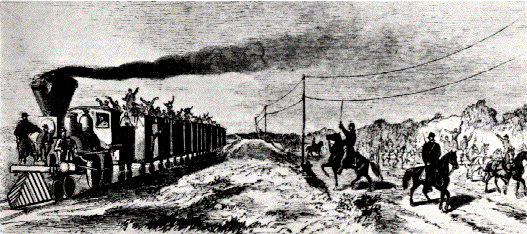
A scene on the L&N Railroad south of Louisville
Bullitt County, like most of Kentucky, was about evenly divided
between sympathizers for the North and those for the South. Two companies
were recruited, one fought for the North, one for the South. Bullitt Countians,
who had been neighbors before the war became opponents during the conflict.
The war had a tremendous social effect on the county as is evidenced by
the lament of several churches in their reports to their conferences or
as- sociations stating the county was in sad shape and experienced a shortage
of young men. Several churches closed their doors during the conflict. No
Major battle was fought in the county, butseveral skirmishes and bridge
burnings did occur.
The county was bisected by the L&N railroad which was the object of
Confederate strategy. Merchants in Louisville circumvented an embargo that
stopped shipment of goods from Louisville to the south by loading the wares
on wagons, taking them to Shepherdsville and placing them on the trains
beading south.
Two men, Dr. Henry Kalfus (USA) and Col. Philip Lee (CSA) organized companies
and marched off to war. Kalfus was a physican from Shepherdsville, Lee was
a lawyer born near Bardstown Junction, but practiced in Shepherdsville.
Dr. Kalfus was of Company D 15th Kentucky Infantry. He, John B. McDowell,
and John L. Foster were captains. The company consisted of the3 captains;
2 first lieutenants; 8 sergents; 10 corporals; the waggoner, Joseph Collier,
the musician,Alfred Hewey and 66 privates. (Speed, Kelly and Pirrle The
Union Regiments of Kentucky p.431).
In the later part of 1862 word was received that Morgan's Cavalry had raided
sections of the L&N between Bowling Green and Elizabethtown and was
advancing toward Elizabethtown. According to Speed, Keely and Pirle (p.
369)
"Co. Harlan started from Gallatin (Tenn.) moving his brigade by cars
as far up the road as they could go, then by rapid marching pushed on to
Elizabethtown in time to engage in a fight with Morgan's men, ten miles
beyond that place on the Rolling Fork Dec. 29, 1862; discovering a force
of the enemy there, he says he ordered up the infantry double quick."
. . . "I (Col. Harlan) went to the front in person, and from a high
hill I saw quite distinctly a very large body of cavalry formed in line
of battle near the river. Their officers were riding along their line apparently
preparing to give us battle. Knowing that Morgan had a larger force than
I had, I proceeded cautiously, and yet, as expeditiously as the nature of
the ground and the circumstances admitted. My men were formed in two lines,
skirmishers were thrown out from both infantry and cavalry, covering our
whole front, and were ordered to advance and engage the enemy, the whole
line following in close supporting distance. The firing commenced, on the
part of the rebels, on our left it was promptly and vigorously responded
to by my skirmishers and the artillery. "After this the confederates
broke forces deciding not to make a full battle. Col. Harlan claims to have
saved the Rolling Fork Bridge as well as the Shepherdsville Bridge."
The 28th Ky. Inf. USA under Lieut. Co. A.Y. Johnson, about the Ist of October
1861 camped at Shepherdsville.The fourth Kentucky Cavalry, recruited in
1861 was composed of companies from Louisville, Jefferson County, Spencer
County and Bullitt County.
Sept. 17, 1861 Gen. Buckner (CSA) seized the L&N and marched for Louisville.
The second Ky. Cavalry responded by riding the train to Leb. Jct. where
they detrained and formed lines to protect the already destroyed bridge.
Also in 1861 the train station at Lebanon Junction was used as headquarters
by General Sherman.
In 1862, besides the burning of the Rolling Fork bridge, confederates under
Morgan destroyed the railroad bridge Sept. 30 and again on Dec. 29 during
his "Christmas Raid." Additionally, a skirmish occured at Mount
Washington on Oct. 3, 4, and 5.
Lebanon Junction was the scene of another skirmish on 1863. At the close
of the War in 1865 two brothers named Wigginton led a band of guerillas
in a conflict with the townfolk at Pitts' Point. Col. Philip Lee was a field
officer in the Second Inf. CSA. His company was also composed of Bullitt
Countians. To this date a list of those who served are not available. Lee's
company called themselves "Salt River Tigers".