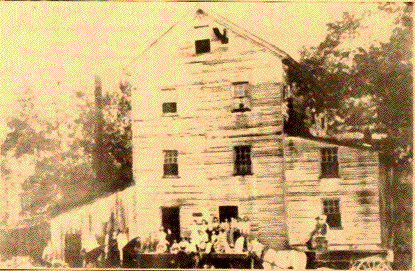
Peter Smith's Mill on Pennsylvania Run
The Little Flock Baptist Church held its first meeting in August
of 1810. Moses Pierson was selected to be pastor in April, 1811. Tradition
has it that the old stone house of worship was built by Peter Smith, who
owned and operated a grist mill on Cedar Creek. Sea biscuits were baked
there and shipped by flat boat to New Orleans by way of Floyds Fork from
Scott's Ford. After unloading the cargo, they sold the flat boat and made
their way back home by land, afoot.
The old stone church was about one and one-half miles from the present site.
It was near the junction of Pennsylvania Run and Cedar Creek, and built
of rough stone. The church was very sinar, having only one room and the
ceiling was low, there were windows on each side of the door. As you entered
there was a fireplace and pulpit, to the left of the door were steps leading
up to the gallery where the slaves and small children of the masters sat
during the worship.
In 1830 Thomas Sanders, John Beckwith and Samuel Pharis made plans to have
a thirty foot addition built on to the church. The church was enjoyed by
all denomina tions, the Baptist having its use one Sunday each month.
Some of the first members of the Little Flock Church were Thomas and Mary
Sanders, Joshua McCauley, Ben Summers, Robert Gailbreath, John and Plly
Beckwith and many others.
The plot of ground of which the present church is built was donated to belong
to the Baptist as long as it was used for a church site, otherwise it was
to revert to Benjamin Summers heirs, the man who gave the land. Mr. Summers
made this generous gift to honor his mother-in-law, Mrs. Polly Beckwith,
a staunch Baptist.
The first janitor for the church was Henry Whitledge, a Negro, in 1820.
He was paid $4.00 a year to furnish suitable and necessary fires, to keep
the floor swept and windows closed. In 1829 Sister Hubbs was to care for
the church for $4.50 per year.
In 1843, Ben Summers took his slaves to the new church site to make the
brick and build the new building. The building seated about 200 people.
There were two front doors, one for men and one for women, and a rear door
for the slaves. The pulpit which had several steps leading up to it was
placed between the two front doors, and the congregation faced the doors.
In those days the church had many slaves as members. They enjoyed all the
privileges of the church, except the right to vote in the meetings. Master
or Mistress and slave were often received into 'the church together.
Some of the Negroes were subjected to discipline. For instance, in 1814,
Bro. Charles was isciplined for riding a horse without permission, but was
acquitted in .1816. In 1819 Sister Nancy was excluded from the church for
stealing soap and flax; Sister Silvia for taking a ribbon from Peter Smith's
store was excluded and whipped bylaw.
For the first 50 years, Little Flock had only five pastors. They were Moses
Pierson, Robert Gailbreath, G. W. Robinson, Rev. R.A. Beauchamp and Dr.
J. A. Ireland.